Friday, May 18, 2012

Magyars


The Magyars were a nomadic tribe that lived in Hungary. Their Ancestors were the Fino-Ugrian people who were located between the Baltic Sea and the Ural Mountains. Originally these people were hunters and fishers. They didn't plant and grow any food.


By 830 AD the Magyars were separated into 3 different hordes or groups and they had an established government. They were living on the Plains of Ural. They had a very basic agricultural system at this point in time. They also were known for doing a lot of horse back.

The Magyars weren't the peacefullest of tribes. Their weapon of choice was the bow and arrow. They had many slaves from raiding other tribes and villages.

Their tribes were divided into even smaller clans. They other tribe members at the top controlling the tribe but not one person in control.

During their existence they had an alliance with another tribe called the Khazars. This alliance didn't last very long and ended with the Magyars migrating away from where they were living. Before moving they elected one person to lead them and be in charge of their tribe his name was Arpad. They came to the slopes of Carpathians.

After moving they started to become very powerful and raided many other tribes.


Image:Viking, Magyar and Saracen Invasions in 9th and 10th Century Europe.jpg
Magyar invasion


By this time the Magyars were starting to be influenced by Christianity which is where their downfall started.

Tuesday, April 24, 2012

The Mahicans


The Mahicans or better known as the Mohicans come from the Eastern Algonquian Native American tribe. Which means they are part of a sub group that speaks a dialect in the Algonquian languages.

The name the tribe called itself was Muh-he-con-nuek (People of the waters that is never still)

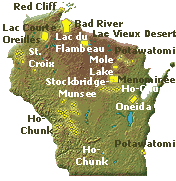
This tribe originally comes from the Hudson River Valley (modern day Albany, NY). Later on in 1680 a lot of them moved to Stockbridge, Massachusetts. Later on in the 1820's and 1830's many descendants made their way to Wisconsin where they joined up with another tribe called the Munsee, they were from then on federally recognized as the Stockbridge-Munsee band of mohican indians.
Mahican territory in Hudson River Valley

Mahicans in Stockbridge, MA territory in 1680's

In this picture they are named at Stockbridge-Munsee

History:

The Mahicans and the Europeans first made contact when the Mahicans were living in the Hudson river valley around 1609. This was the time when the settlement of New Netherland was being built up.  During this time of encounter the Mohicans were not one tribe but a tribe with 4 smaller subgroups called Westenhuck, Wawayachtonoc, Mechkentowoon, and Wiekagjoc. For the next hundred years the was difficulties between the Mahicans and the the Iroquois Mohawk, also the Dutch, and the English settlers. This was the reason they immigrated towards the east to Massachusetts and Connecticut. When they came here they started to be known as the Stockbridge Indians. After living here for awhile they started to allow other white people live with them who were Protestant Christian Missionaries. In the 18th century many converted to christianity but they kept some of their own traditions. In the French and Indian wars they fought on the USA side. Even with their loyalty they were also forced off of their land and pushed westward. Many moved decided instead to move to New Stockholm, NY. They were promised land and then pushed onto reservations in Wisconsin in the 1820's and 30's. The Mahicans were one tribe that was really influenced by the christian religion and was a part of it quite a bit. Eventually however, their language became extinct and they no longer lived freely.


The last of the Mohicans:

The Mohicans became famous from a novel called the Last of the Mohicans by James Fenimore Cooper.


Last of the Mohicans, Merrill bear.jpg
Cover of the Last of the Mohicans


Monday, February 13, 2012

The Blackfoot

"What is life? It is the flash of a firefly in the night. It is the breath of a buffalo in the wintertime. It is the little shadow which runs across the grass and loses itself in the sunset."
~ Crowfoot, Blackfoot warrior and orator


      The Blackfoot also known as Siksika or the Niitsitapi were Native American tribe settled in the area of Canada and Montana before white settlers came.
Blackfoot territory before White settlement
            After the white settlers came the Blackfoot were pushed into a smaller territory within Idaho and Montana and they remain there today.

Modern Day Territory 


History of the Blackfoot:

According to anthropologist


The blackfoot or otherwise known as the Siksika are a tribe that originally come from the territory from the North Saskatchewan river, Canada to the headstreams of missouri in Montana In modern day they live in reservations in Montana and Idaho. They get their name from the black moccasins that were believed to be discolored by the ashes and soot from fire.


The Blackfoot were the largest tribe in Montana and was split up into 3 different sub-groups: Siksika, Kaina, and Pikûna. However they all spoke the same language and each had their own different chiefs, sun dance, and council. The three groups were almost like independant tribes.

As it is known, the Blackfoot were amazing buffalo hunters. They lived in tipis and were nomadic, moving around  and not staying in a permanent location for too long. Before the 1800's they had no horses, so they had to do everything by foot including hunting. Then the settlers came and brought horses along with them which was brought into the Blackfoot's life. During the 1800's however they gathered many horses from other tribes and were then known on for having great horse herds.

The Blackfoot were known for being a very aggressive tribe and were always at war with their neighbors. They were also very aggressive to the americans.


Sources:

http://www.accessgenealogy.com/native/tribes/blackfeet/blackfeetindiantribe.htm

http://www.neokistomi.com/blackfeet.html

Wednesday, February 1, 2012

The Khoisan

The Khoisan is an African tribe that has been located in Southern Africa. They have been located in this area even before the dutch made contact there in 1652. Proof of their consistent existence is found by the language distribution and how it has changed and been influenced in that area over time.  File:African language families en.svg

For awhile the Khoisan were agriculturist, but once the land grew dryer and the resources became scarce they finally resulted to being hunter-gatherers and remain to be today.

The Khoisan is split up into two groups based off of culture: the Foraging San and the Pastorai Khoi.

Modern science has taken a look at the men's Y chromosomes and found that the patterns are distinct to all the other populations. This research has helped find that the ancestry of the Khoisans may have been the fist to be different from the most recent common paternal ancestor of all extent humans. It also shows that the populations ancestry goes back some 60,000 to 90,000 years ago.

The Khoisan's physical appearance consists of a short frame with copper-brown skin, their hair is slightly coiled, high cheekbones, and epicanthic eye folds. They have pretty long legs and smaller stomachs.

Tuesday, January 31, 2012

Introduction to Our Class

Dear Reader,

This year our class is studying world history. We started with talking about hunter-gatherers and then moved into talking about civilization, religions, the rise of classes, warfare, etc. Through the twist and turns we have been seeing in mans crazy past we try to look at all aspects in a non-critical way in order to fully understand and accept the past laid out for us. Now we are reading the book Ishmael and we are focusing on the so called, "Takers and Leavers". Now we are trying to find examples of 2-3 leaver groups and doing research on them. We can use leavers from history to modern day leavers. Then leave some basic information on a post that will lead to us choosing one and focussing on that one. But first we need to find who they are, where they live(d), when did they live, what do we know about them them, and why we are interested in researching them. Through this we will gain a better and more accurate understanding of the leaver communities of the world and how it has shifted to become mostly a world of takers.


thank you,


Alexa